Hanover's Summer Now Happens on the Green
It's a Wednesday afternoon in early August, and the vendors setting up folding tables on the Dartmouth Green already know the drill: produce boxes here, the flower guy there, someone's kid weaving between camp chairs with a dog on a leash. By four o'clock the market is in full swing. By six, in past summers, it would have folded up and gone quiet, the Green settling back into its usual role as the patch of grass people cross on the way somewhere else.
This summer, that's no longer quite true. A few dozen yards away, the glass wing of the newly reopened Hopkins Center catches the late light, and on certain Wednesdays, the crowd that came for tomatoes and cut flowers doesn't leave when the last vendor packs up. They wait for what's happening after dinner. That shift, small as it sounds, is the story of Hanover's summer this year.
For anyone who's lived here a while, it's easy to forget how long the Hop was simply gone. Construction on the $123.8 million expansion and renewal of the Hopkins Center for the Arts ran from the winter of 2022 through the fall of 2025, and for most of that stretch the building sat behind fencing while Hanover's evening life reorganized itself around whatever was still open on Main Street.
What came back wasn't just a repaired version of the old Hop. Designed by the internationally renowned firm Snøhetta, the project added the 15,000-square-foot Daryl and Steven Roth Wing, a new addition built with curved glass and copper-toned steel on the side facing the Green, a design choice that made the building's newest, most expensive feature literally look outward at the lawn instead of inward at the campus. The original 1962 building, designed by Wallace Harrison, informed the same architect's later work on the Metropolitan Opera House at Lincoln Center, a detail Hanover residents can now bring up at dinner parties with real authority.
Students and faculty got the building back at the start of fall term 2025. The public grand opening ran October 16 through 19, with full visiting-artist programming resuming that winter. Which means this is the first summer the reopened Hop has had to figure out what it wants to be to the town, not just the college.
Executive director Mary Lou Aleskie put the intention plainly when the renovation wrapped: "What we really want to let people know is that the arts at Dartmouth are a powerhouse." The building's answer to that, at least this summer, has been to move a chunk of its programming outside, onto the one piece of ground everyone in Hanover already crosses anyway.
The free concerts started in July, and the timing wasn't an accident:
Both of the free, all-ages Green concerts landed on Wednesdays, the same day the farmers market has run for years. So did the next family event. None of this required driving to Lebanon or waiting for a festival weekend. It happened on the Green, on market day, because the building overlooking it was built this time to treat that lawn as part of its stage.
The Hanover Farmers Market hasn't changed. It still runs every Wednesday from 3 to 6 p.m. on the Green, rain or shine, through mid-October, with the same mix of produce, cheese, prepared food, crafts, and live local music it's had for years. That consistency is exactly why this summer's shift is worth noticing.
In the years the Hop sat dark, a Wednesday market that ended at six had no real reason to hold anyone past that hour. The lawn cleared, the tables folded, and Hanover's evening moved to wherever dinner was. This July, on the two Wednesdays the market shared its afternoon with a free Hop concert, the same lawn that hosted the 3 o'clock produce tables held a blanket-and-lawn-chair crowd well into the evening. The market didn't get longer. The Green just stopped emptying out when it ended.
The Green isn't the only thing that changed shape on this side of town. A short walk up Rope Ferry Road, Pine Park, the oldest conservation land in Hanover, has quietly gotten easier to get into.
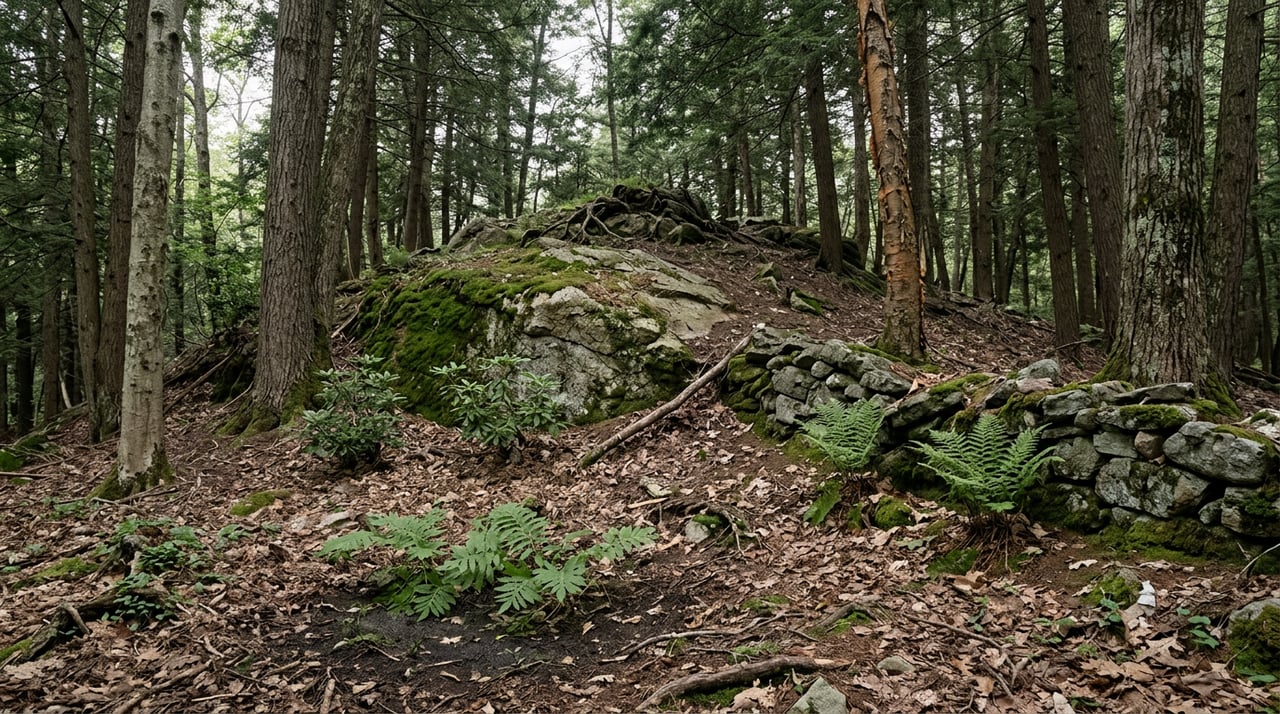
The land's origin story is worth knowing on its own. In 1899, a group of seventeen Hanover residents bought the first parcels specifically to stop the Diamond Match Company from logging the riverbank for matchsticks. The Pine Park Association formed in 1905 to manage what they'd protected, and the park has since grown to roughly 100 acres with more than six miles of trail winding along the Connecticut River and Girl Brook.
What's new is the entrance. With the Hanover Country Club's closure, nine acres of former fairway were reclaimed to build an all-person entrance trail off Rope Ferry Road. The first 2,100 feet run on a firm stone-dust surface with gradual inclines and benches along the way, a version of Pine Park that doesn't require the steep, root-crossed descents the older river-side entrances are known for.
It's a small infrastructure change, but it lands the same way the Hop's reopening does. Both projects took land or buildings that used to serve a narrower purpose, a private golf course, a campus performance hall, and opened them up to whoever happens to live nearby. Neither one was built to change how Hanover sells houses. Both of them have quietly changed how Hanover spends a Wednesday.
If your mental map of Hanover still treats the Green as the grass you cross on the way into town, this is the summer to update it. The market runs through mid-October regardless, so that part of your Wednesday isn't going anywhere. But the next free community date, August 19's Family HopStop, is worth building an evening around rather than treating as background noise on the way to dinner somewhere else.
And if Pine Park has always felt like a trail for people with steadier knees than yours, the new Rope Ferry entrance was built with exactly that hesitation in mind.
None of this required a single new restaurant or a ribbon-cutting on Main Street. It took one $123.8 million building deciding to face the lawn instead of the quad, and one land trust deciding a golf course closure was an opportunity instead of a loss. Hanover's center of gravity didn't move across town. It moved about fifty yards, onto ground that was always there.
Dolan Real Estate keeps a close watch on Hanover and the rest of the Upper Valley and Lake Sunapee region because small shifts like an arts center's new orientation or a trail's new front door tell you more about where a town's attention is headed than any listing ever will. If you're curious what else is changing in the neighborhoods we cover, request a personalized consultation and we'll walk you through what we're seeing.
September 24, 2026
September 17, 2026

September 10, 2026
September 3, 2026
August 27, 2026
August 20, 2026
August 13, 2026
August 6, 2026
August 6, 2026
Dolan Real Estate has established a locally owned and operated real estate firm that surpasses the services offered by larger, franchise-based companies. Their clients can attest to the exceptional quality of their work.