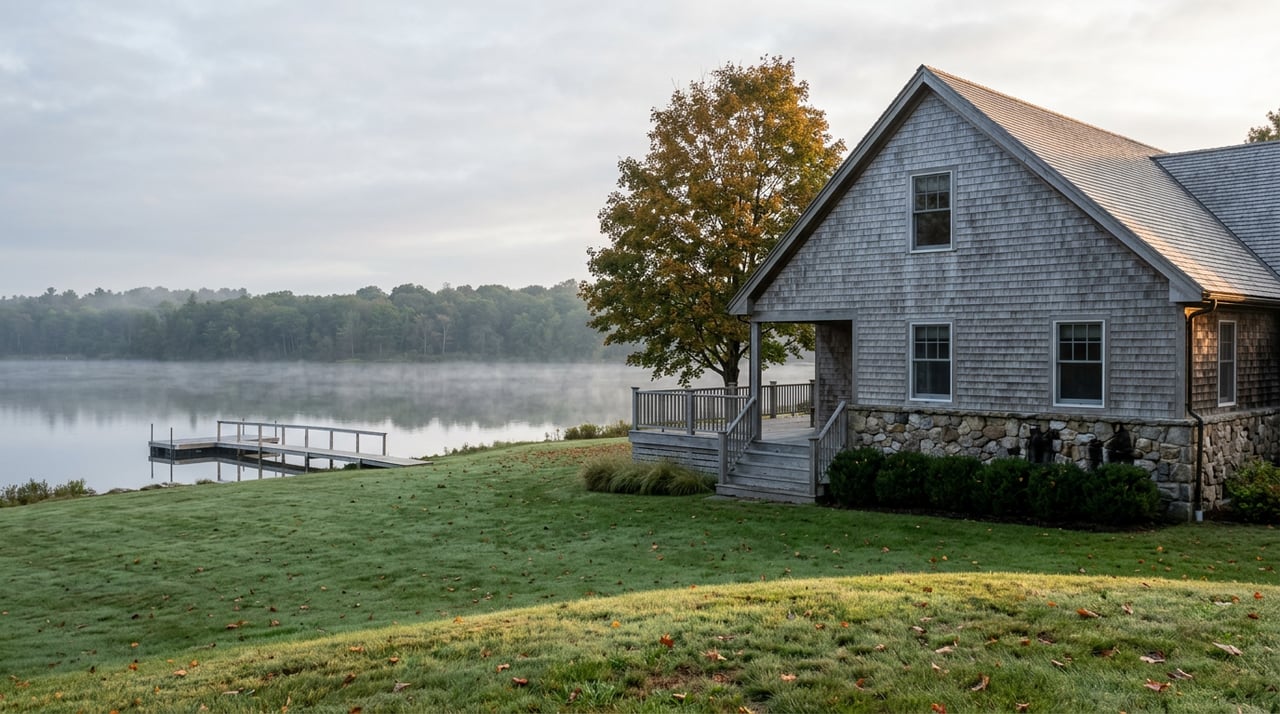
Sutton's Lake Homes Cost Less to Buy. They Don't Cost Less to Own.
A buyer comparing Kezar Lake in Sutton against Lake Sunapee frontage in Newbury or Sunapee proper usually does the math the same way. Pull up two listings, similar square footage, similar lake access, similar price per square foot. Sutton looks like the value play. Then the tax card arrives after closing, and the number on it doesn't match the story the listing told.
That gap isn't a mistake and it isn't random. It's a function of how New Hampshire actually pays for schools, and it means two towns that look interchangeable on a listing sheet can cost meaningfully different amounts to hold for the next ten years.
As of the most recent tax-year filings set in late 2025, the four towns that anchor this stretch of the Lake Sunapee region carry very different rates per $1,000 of assessed value:
| Town | 2025 Tax Rate (per $1,000) |
|---|---|
| Newbury | $10.48 |
| Sunapee | $10.55 |
| New London | $11.86 |
| Sutton | $16.61 |
Sutton's rate is roughly 50 to 60 percent higher than Newbury's or Sunapee's, and about 40 percent higher than New London's. These aren't old numbers dressed up as current. They're the rates each town set for the 2025 tax year, which is what buyers are paying against today.
Before drawing a conclusion, it's worth ruling out the explanations that seem obvious but don't hold up:
What actually drives the gap is the size and shape of each town's grand list, meaning the total assessed value of everything a town can tax, relative to what it costs to run the schools and services those residents use.
The rate you pay isn't a reflection of your house. It's a reflection of everyone else's house on the same tax roll.
Here's a detail that rarely makes it into a market comparison but explains a lot: New London, Newbury, and Sunapee have formalized their relationship on this exact issue. The three towns operate under an intermunicipal agreement, sharing a single full-time assessor and related resources across all three communities. A joint board with representatives from each town oversees that shared assessor, approves the operating budget, and apportions costs primarily by each town's share of the total parcels being assessed.
Sutton isn't part of that arrangement. That's not a criticism of Sutton's town government. It's a structural fact that reflects a different reality on the ground: Newbury and Sunapee sit directly on Lake Sunapee, with a dense concentration of high-value waterfront property that doesn't add proportionally more children to the school census. New London anchors the commercial and institutional core of the same tri-town assessing zone. Sutton, with a smaller and lower-profile lake in Kezar, doesn't have the same concentration of high-value, low-school-impact parcels to spread its costs across.
New Hampshire funds its schools primarily through local property taxes, since the state levies no broad-based income tax on wages. That means the tax rate in any given town is essentially a fraction: total budget needs divided by total assessed value. A $2 million-dollar lakefront estate on Lake Sunapee sends the same number of kids to school as a $400,000 house a mile inland, but it contributes far more to the denominator. The more of those high-value, low-enrollment-impact properties a town has on its rolls, the lower the rate has to be to raise the same dollars.
Sutton doesn't have a shoreline with the same concentration of trophy-value waterfront. Kezar Lake is real, and it's genuinely desirable, but it's a smaller lake with a smaller band of premium-assessed shorefront to carry a disproportionate share of the load. The town's tax base is built more on ordinary residential and rural parcels, which means the same school and municipal budget gets divided across a base with less high-end ballast.
The rate differences sound abstract until you apply them to an actual price point. Sutton's median list price in May 2026 was $714,000. Run that same purchase price through each town's 2025 rate and the annual property tax bill looks like this:
| Town | Rate | Annual Tax on a $714,000 Home |
|---|---|---|
| Newbury | $10.48 | about $7,480 |
| Sunapee | $10.55 | about $7,530 |
| New London | $11.86 | about $8,470 |
| Sutton | $16.61 | about $11,860 |
That's a difference of roughly $4,300 to $4,400 a year between owning in Sutton versus Newbury or Sunapee at the same price point, and about $3,400 a year versus New London. Over a decade of ownership, that's tens of thousands of dollars that never shows up in the sale price comparison a buyer runs before making an offer.
None of this means Sutton is a bad buy. It means the calculus is different than a side-by-side price comparison suggests, and the demand data backs that up. Homes in Sutton spent a median of just 50 days on market in May 2026, a 25 percent decrease from the year before, at a median value of about $320 per square foot. Buyers are absorbing the higher carrying cost, and they're doing it quickly.
Part of the reason is that Kezar Lake itself is a scarce asset independent of the tax picture. The lake spans roughly 170 acres in the town of Sutton, offering swimming, boating, and fishing for species including rainbow trout, brown trout, and smallmouth and largemouth bass, with Wadleigh State Park providing shorebank access on the southern end. Waterfront and near-waterfront inventory on Kezar Lake is thin in most years, with very few homes or vacant lots reaching the market at any given time. When a lake has that little turnover, the higher annual tax line becomes one more input in a buying decision, not the deciding factor.
If you're cross-shopping Sutton against Newbury, Sunapee, or New London, the sale price and the price per square foot only tell you what you'll owe the seller. They don't tell you what you'll owe the town every year after that. Before you get attached to a number on a listing sheet, ask for the actual current-year tax bill on that specific parcel and run it against a comparable property in the town next door. The rate gap here is real, it's structural, and it's not going to close because a buyer wishes it would.
None of that makes Kezar Lake a worse place to own. It makes it a different kind of hold, one where the appeal is a quieter lake, a tighter supply of homes that come to market, and a rural character that Lake Sunapee's more built-up shoreline doesn't have. The right comparison isn't which town is cheaper. It's which set of tradeoffs, tax rate included, matches what you're actually buying the place to do.
Does Sutton's higher rate mean the town is worse funded than its neighbors? No. It means Sutton's grand list has less high-value, low-enrollment-impact property to spread the same budget across. The rate is a function of the tax base, not a judgment on town management.
Could Sutton eventually join a shared assessing arrangement like New London, Newbury, and Sunapee have? That would be a decision for Sutton's town government and voters, and nothing in the public record suggests it's currently under consideration. For now, Sutton assesses independently.
Is the tax rate gap likely to change soon? Rates are set annually and can shift with revaluation cycles and local budget votes. The 2025 rates cited here reflect the most recent filings available, and any town's rate for 2026 won't be finalized until late in the year.
If you're weighing a purchase on Kezar Lake against something on Lake Sunapee proper, the numbers above are a starting point, not the whole picture. The team at Jessica Dolan works across Sutton, Newbury, Sunapee, and New London every week and can walk you through the actual current-year tax bill on any specific property you're considering, not just the town-wide average. Request a personalized consultation before you make an offer, so the tax rate is a known quantity going in, not a surprise waiting at the closing table.
September 24, 2026
September 17, 2026

September 10, 2026
September 3, 2026
August 27, 2026
August 20, 2026
August 13, 2026
August 6, 2026
August 6, 2026
Dolan Real Estate has established a locally owned and operated real estate firm that surpasses the services offered by larger, franchise-based companies. Their clients can attest to the exceptional quality of their work.