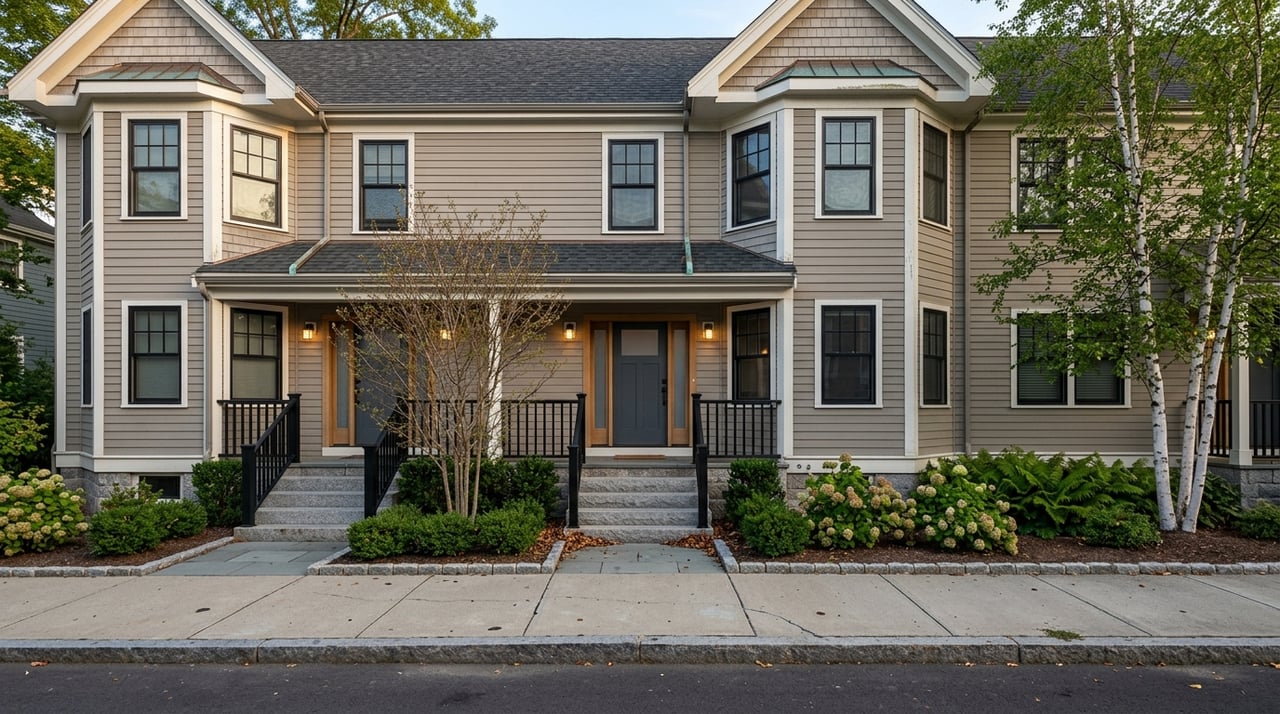
Lebanon NH Investment Property: Condos vs. Multi-Family
If you are looking for a small-scale investment property in the Upper Valley, Lebanon deserves a close look. This market has a rare mix of steady employment, a sizable renter base, and housing demand tied to major institutions, but it also comes with real underwriting challenges that you need to understand before you buy. In this guide, you’ll get a practical look at what to know about investing in condos and multi-family homes in Lebanon, New Hampshire, so you can evaluate opportunities with more confidence. Let’s dive in.
Lebanon is a relatively small city, but it has important fundamentals that support residential demand. The Census Bureau estimates the population at 15,389 in 2024, up 7.7% from 2020, and the city is close to evenly split between owners and renters, with a 49.8% owner-occupied housing rate.
That balance matters if you are considering a condo as a lower-maintenance rental or a duplex or triplex as an income property. You are not looking at a market that depends on one type of household alone. Instead, Lebanon has a mix of residents, renters, and new arrivals who need housing at different price points.
Employment is a major reason demand stays in focus here. Dartmouth Health reports more than 16,000 employees, and DHMC is located in Lebanon, while nearby Dartmouth College adds another large layer of regional housing demand. The city’s housing needs assessment also identifies health care and social assistance as the largest employment sector in Lebanon, with 8,398 jobs.
Lebanon’s housing needs assessment says renter-occupied units are concentrated downtown and around DHMC. It also notes that DHMC leases many rental units for employees, and those tenants may stay for shorter periods.
For you as an investor, that means location plays a major role in how a property performs. A condo or small multi-family near downtown services, major employers, or commuting routes may appeal to renters who prioritize convenience and flexibility.
It also means turnover assumptions should be realistic. In some cases, you may be serving a tenant base connected to job changes, relocation, or shorter-term work assignments rather than only long-term households.
Condo pricing in Lebanon currently spans a wide range. Current listings cited in the research report run from about $145,000 to $649,000, with examples in the mid-$300,000s, low-$400,000s, and above $600,000.
That range gives you more than one entry point into the market. If you want a lower-price option with potentially simpler maintenance, a condo may be the easiest way to gain exposure to Lebanon real estate without taking on the full complexity of a multi-unit building.
Still, condo investing requires careful review beyond the asking price. You will want to look closely at association rules, monthly dues, reserve health, and whether leasing restrictions affect your plans. Even in a strong rental market, those details can shape your actual return.
For small multi-family properties, current Lebanon duplex and triplex listings in the research report range from $400,000 to $725,000. That pricing puts many of the available opportunities in a range where property taxes, financing costs, and renovation scope can quickly affect cash flow.
A duplex or triplex can offer more control than a condo because you are not subject to condo association governance. You may also have more room to improve value through unit updates, parking improvements, or operational changes.
At the same time, a small multi-family often demands more active oversight. Maintenance, tenant coordination, capital planning, and turnover costs can be more hands-on, especially in an older property or one that needs modernization.
Lebanon’s long-run rent trend has been strong. According to the city’s housing needs assessment, median gross rent rose from $1,163 in 2010 to $2,448 in 2023.
More recent rent snapshots vary depending on the source, which is important for your underwriting. The research report notes average rent estimates of $2,394 from Zillow, $2,731 from Apartments.com, and a median of $2,125 from Zumper, with condo average rent around $2,112.
The safest takeaway is simple: do not rely on one citywide number. You should verify unit-specific rental comps based on size, condition, layout, parking, and location. That is especially true in a market where newer product and older housing stock can produce very different rent outcomes.
Lebanon can look attractive on paper because rents are relatively strong for a city of its size. But strong demand does not automatically mean every purchase will perform well.
The city’s own housing analysis suggests a practical approach. Model conservative rent growth, account for meaningful tax carry, and focus on upgrades that improve energy efficiency, unit function, and parking.
That approach can help you avoid overestimating future income. It also keeps your strategy grounded in what local renters are actually responding to today.
On one hand, Lebanon still shows signs of a tight housing market. The city reports an ACS-based renter vacancy rate of 3.1% in 2023, and it notes that a healthy vacancy rate usually runs between 5% and 8%.
On the other hand, the city’s August 2025 market analysis projects multifamily vacancy in the 7.5% to 8.5% range through 2026. That increase reflects new deliveries and a slower pace of absorption, with the market absorbing about 14 units per quarter on average.
This is one of the most important points for investors right now. Lebanon has strong long-term demand drivers, but it also has a meaningful development pipeline. The broader pipeline includes roughly 1,844 units completed or under construction, plus 1,140 approved and 507 conceptual or review-stage units.
New supply is concentrated in studio, one-bedroom, and two-bedroom apartments. If you are buying a condo or smaller multi-family property, that creates direct competition in some of the same renter segments.
That does not mean you should avoid the market. It means you should be selective about the asset you buy and realistic about how it competes. A well-located property with updated finishes, practical layouts, and reliable parking may stand out better than a property that is only average.
Property taxes are a major carrying cost in Lebanon. The city’s 2025 tax rate is $21.53 per $1,000 of assessed value.
Using the city’s examples, that works out to about $9,688.50 per year on a $450,000 property and about $12,918 per year on a $600,000 property. Tax bills are generally due July 1 and December 1, and late interest begins after 31 days.
For investors, this is not a detail to gloss over. If you are comparing Lebanon to another market, taxes can materially affect your monthly numbers and your long-term hold strategy.
Lebanon’s zoning ordinance is relatively supportive of small-scale density. The research report notes that mixed-use buildings are permitted in all zoning districts, and the Central Business district is intended to facilitate smart growth and higher-density residential uses.
For multi-family properties, density review is based on factors such as parking, water and sewer, and site improvements. The minimum off-street parking standard is one space per apartment unit, though alternative parking solutions may be approved.
If you are exploring a property with expansion potential, conversion potential, or a reconfiguration plan, these local requirements matter. Early review of parking and site constraints can save you time and help you avoid overestimating what the property can become.
In Lebanon, value-add is not just about buying an old building and updating finishes. The city’s housing analysis suggests that demand is shaped by modernization, energy efficiency, and location.
That is useful because it helps you focus your renovation budget. Improvements that make a unit easier to live in, less expensive to operate, and more functional for day-to-day use may have more impact than cosmetic updates alone.
Some practical priorities may include:
The city also notes that some of the highest median values are found in older-home areas. That suggests renovation quality and location both matter, rather than age alone.
If you are deciding between a condo and a small multi-family property in Lebanon, the right choice depends on your goals, budget, and time horizon.
| Property Type | Potential Advantages | Potential Watchouts |
|---|---|---|
| Condo | Lower entry price in some cases, simpler exterior maintenance, easier entry into the market | Condo dues, leasing restrictions, less control over building decisions |
| Duplex or Triplex | More control, multiple income streams, clearer value-add options | Higher maintenance responsibility, more operational complexity, larger tax and capital expenses |
A condo may fit you best if you want a simpler investment or a foothold in the market with less hands-on management. A small multi-family may make more sense if you are comfortable managing more moving parts in exchange for greater control and upside potential.
Before you make an offer, it helps to pressure-test the numbers and the location with local realities in mind.
Here are a few smart questions to ask:
A property does not need to be perfect to be a good investment. But in a market with both strong demand and growing supply, the margin for error gets smaller if you buy based on broad averages instead of property-specific facts.
Lebanon offers real strengths for small-scale residential investors. Population growth, major employment anchors, historically strong rent growth, and a renter base tied to local institutions all support the case for buying here.
At the same time, this is not a market where you can skip the details. Rising supply, variable rent data, and significant property tax carry mean the best opportunities usually come from careful underwriting and a clear understanding of how a specific property will compete.
If you are thinking about buying a condo, duplex, or triplex in Lebanon, local guidance can make a meaningful difference. For personalized help evaluating opportunities in the Upper Valley, connect with Jessica Dolan.
October 15, 2026
October 8, 2026
October 1, 2026
September 24, 2026
September 17, 2026

September 10, 2026
September 3, 2026

August 27, 2026
August 20, 2026
Dolan Real Estate has established a locally owned and operated real estate firm that surpasses the services offered by larger, franchise-based companies. Their clients can attest to the exceptional quality of their work.